• Skip to primary navigation
  • Skip to main content

Marketing Advisor, Mentor, & Educator

Kevin C. Whelan

Subscribe
  • About
  • Services
    • 1:1 Mentoring
    • Pick My Brain
    • Consulting
  • Products
    • Membership
    • Advisor OS
  • Resources
    • Mailing List
    • Articles
    • YouTube
    • Podcast
  • Contact

All Audiences

February 4, 2021

The purpose of your website

What’s the purpose of your website?

For me, it does two things:

  1. Builds relationships
  2. Sells my products and services

It helps build relationships using two main factors: educational content and an email mailing list sign-up form. 

My newsletter is where I continue building the relationship via email, so that’s the gateway to deeper relationships.

It helps sell my services by listing what I do, who I do, how I do it for, and how much things cost.

But the thing is, nobody buys without building a relationship with me first, no matter how “productized” I make my services.

Which means the primary focus of my website should be to optimize for relationship building.

And that means my home page should be prioritized the same way. It should focus on building the relationships.

So, I updated my home page today to include an email subscription form at the top.

I also better articulated what I do, who I do it for, and why someone should subscribe to my email list.

Previously, it was vague about who should read. And the email subscribe form was buried several full article lengths down the page.

Now it’s right at the top. Organized and easy to understand (I hope).

I’m never done, but there’s one thing that’s for sure: always make the main thing the main thing.

Optimize every page on your site according to that page’s primary goal. In my case, I don’t try to sell on the home page. That wouldn’t work anyway.

Instead, I try to build a relationship with content and a reason to subscribe to my mailing list (where the real relationship gets built).

Here’s the new home page top section (followed by several full articles). A snapshot in time which will inevitably change.
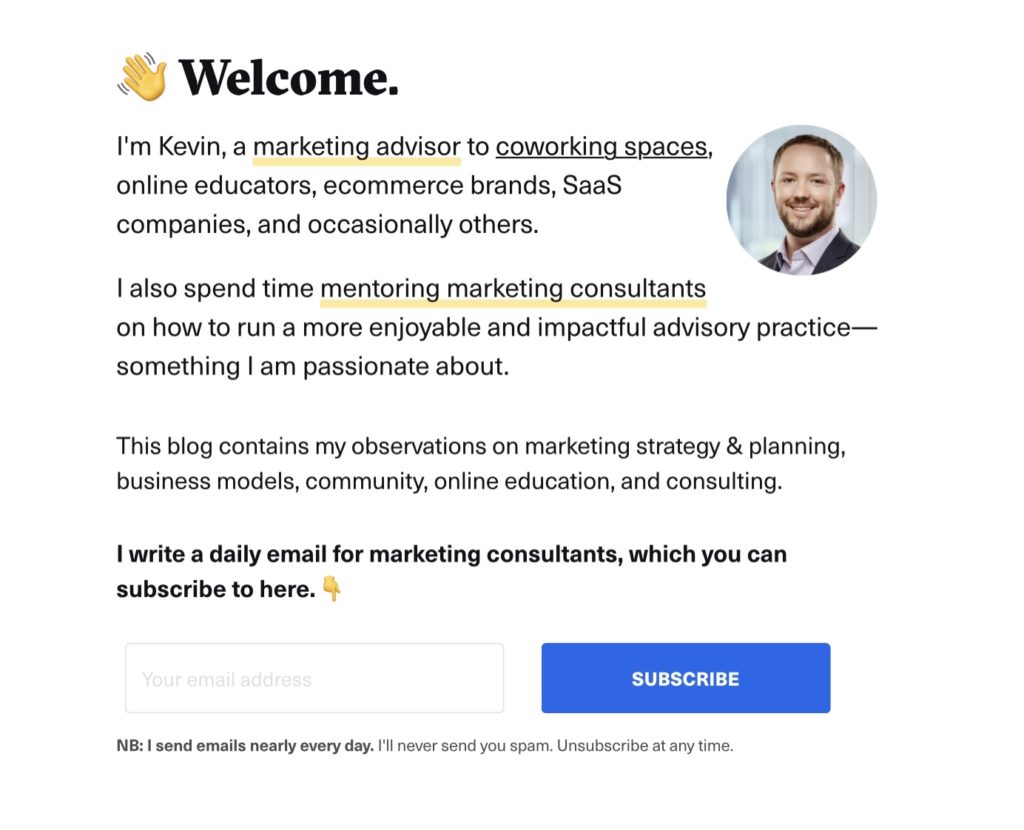
 

Home Page Screenshot - February 2021

February 3, 2021

The five kinds of content

As far as I can tell, there are only five kinds of content:

  1. Education: teach people something
  2. Entertainment: create an experience people enjoy
  3. Stories: talk about someone or something that happened
  4. Curation: find neat things and bring it to people
  5. A blend of multiple: infusing multiple kinds of these into one

I tend to focus on education, with a few stories and the occasional curation piece built in.

But if I’m honest, that’s not the best plan to use. It’s just my default.

The best content strategy uses a healthy mix of all of these content categories.

Sometimes we want junk food, sometimes we want the main course. If you give people too much of the same thing, they get bored.

See if the above categories work for you as a prompt to keep your next content piece fresh.

This one was an “education” piece, but I’ll switch it up tomorrow and mix some more together.

Until next time!

February 2, 2021

Be unreasonably reliable

Writing and publishing every day says something.

Even if your writing isn’t perfect, the fact that you show up consistently each day sends a clear message.

It says that you’re reliable. You’re committed, even when it’s hard. You’re a professional.

And that’s rare.

In a world full of low competence, no follow-through, and wavering levels of consistency, showing up every day demonstrates dependability.

And because it’s rare, people notice it. They’re looking for signs of dependability. You stand out.

Be unreasonably reliable. That’s where the value is.

January 29, 2021

Directionally accurate

You don’t have to know where you’re going. You don’t even have to know how to get there. You just need to be directionally accurate. 

Move in the directions of your goals and intuition, watch for feedback, and iterate until you get there.

It’s not business travel, it’s a road trip.

January 26, 2021

Strategy, systems, processes, and results

In order to get consistent and predictable results from your marketing, you need to have a system.

Of course, your system should be based on a strategy. But as important as your strategy is, it’s the systems that produce results consistently over time.

Without a system, you have haphazard activities and inconsistent results.

Processes, on the other hand, become the instruction manual for the system. They’re the step-by-step breakdown of each part of the system.

These might seem mundane at first blush, but they’re critical.

You can get a rocket to space with a good system, but only if you follow the individual processes within it.

As a marketing advisor, I break things down into four core parts: strategy, systems, processes, and results.

Results (or lack thereof) should be analyzed at one or more of those four levels using quantifiable data.

When things go wrong, the focus should be turned towards fixing the part of the system that didn’t work. Like the Wright brothers when they built the airplane, they kept iterating on the system until it worked.

A lot of people run marketing program without any of the four parts I mentioned in place. That’s why their results are so inconsistent.

If you want to get consistent, repeatable results from your marketing, try breaking down your efforts into those four parts.

Treat it like an object outside of any one individual. Everything is documented and set to a specific timeline of events. It’s a machine you constantly tweak and improve.

Build the system, set it to a schedule that works for you, tweak it as much as needed, and document it along the way.

January 23, 2021

If you don’t know what to write, start writing

One of the beautiful things about writing daily (or producing any kind of content daily) is that it forces you to find things to talk about.

It can be hard to come up with new ideas every day. I’ve shared ideas on this before, such as writing for one real person, keeping a list of topics to write about, doing research on what your target market wants to consume, etc.

But one of the best ways to come up with an idea is just start writing.

You might begin with a random idea that doesn’t flow right. You might start again on the same page. Then a third time, you find yourself writing about something that just clicks.

Suddenly, your writing flows. The ideas make sense.

And there you have it, you have created a topic by writing until something finally clicked. You weren’t short of ideas, you just didn’t have momentum.

So, if you’re stuck on what to write about, there’s no excuse if you haven’t sat down and just tried writing.

Try one of the other tips above, sure. But writing begets more writing.

The ideas will come if you’re in motion.

January 22, 2021

The disproportionate upsides and downsides

Something in your business isn’t working. It’s small.

Maybe it’s a service you offer, or a client you work with, or an idea that isn’t taking off. And it’s causing disproportionate downside for you.

Maybe the downside is stress, or high time commitment with minimal reward, or nobody is buying. Whatever it is, it’s worth noticing and dealing with.

The flip side is also true.

Smaller parts of your business are working extraordinarily well.

Maybe it’s the type of clients you work with or a service you offer that you love selling and delivering.

And compared to everything else, it brings disproportionate returns. Whatever it is, it’s worth noticing and doubling down on. 

Of course, this is the 80/20 principal at play. 

The more you remove the 20% of things causing 80% of the downside, the more you free up your time and energy to do more productive things.

The more you do the few things that are causing disproportionate benefit, the more your business will grow and the happier you’ll be.

You know this already. I’m just here to remind you to actually evaluate any part of your business for this pattern and act on it.

January 21, 2021

The thing about numbers

Most of business and marketing can be reduced down to numbers.

It might be number of blog posts you published, number of leads you got, total revenue, cost per acquisition, or a whole range of other metrics.

You can then use statistics and analysis to make assumptions or give you an indication of directional success.

Running a business requires a combination of numbers and some degree of subjectivity and gut instinct.

But if you really want to improve your situation, the best way is to break things down into numbers.

Could be dollars, hours, inputs, profit, or even subjective things like quality score.

Our gut instinct is important, but it’s even better when you have numbers.

And without numbers, you’ll always be surprised. Usually, not in a good way.

Track, measure, and improve those numbers.

January 20, 2021

The thing about limiting beliefs

I like to ask people where they see themselves in 12-18 months. The answers I get are often surprisingly below their potential.

The reason for that is we all carry limiting beliefs about what’s possible. What’s possible for tomorrow feels contingent on what happened yesterday.

The best way to fix that is with outside perspective from someone who’s done what you’re trying to do. These people can tell you when you’re just plain wrong.

This happened to me today with someone I mentor.

I asked them where they wanted to be in the next year or so and they said they could imagine having three advisory clients at the most.

I said they could do more.

They recently starting using my consulting framework, which allows me to handle up to 10 clients at a time, plus some group coaching and membership programs.

Why not them, too?

You can serve more than three people as an advisor at one time if you’re doing it right. A little experience, belief in yourself, and the proper design of your services can go a long way.

So as you’re planning your 2021, I encourage you take a moonshot.

Ask yourself, if I could hit a higher target, what would need to happen in my business to do so?

And what am I making harder than it needs to be? How would I design my business in a way that makes even more profit AND more impact?

Those are questions of value. Ask them to yourself, talk to someone who’s done it before, and raise your targets.

You might surprise yourself.

January 19, 2021

Your business is a system

Your business is a system.

Maybe it operates haphazardly, or maybe it runs like a swiss watch.

Either way, it’s a system.

And anything new you take on, whether it be a client, project, activity, or task, becomes a piece in that system.

The key is to assimilate things slowly so they fit into your system. And almost nothing fits by default.

You have to be intentional if you hope to run your business (and life) like a well-oiled machine. It means considering each new input and idea, scoping it out, and seeing if it will work in your machine before taking it on.

Too often we take on new responsibilities and assimilate things that don’t fit into our business. Which then creates a system breakdown.

Your goal is to keep your system running smoothly. Doing that means being judicious about what you let into it in the first place.

Guard your system, run it smoothly.

  • « Go to Previous Page
  • Go to page 1
  • Interim pages omitted …
  • Go to page 15
  • Go to page 16
  • Go to page 17
  • Go to page 18
  • Go to page 19
  • Interim pages omitted …
  • Go to page 22
  • Go to Next Page »

More:  Consulting · YouTube · Contact

Member Login

Please don’t reproduce anything on this website without permission.

Copyright © 2026 · Kevin C. Whelan · All prices in USD.