• Skip to primary navigation
  • Skip to main content

Marketing Advisor, Mentor, & Educator

Kevin C. Whelan

Subscribe
  • About
  • Services
    • 1:1 Mentoring
    • Pick My Brain
    • Consulting
  • Products
    • Membership
    • Advisor OS
  • Resources
    • Mailing List
    • Articles
    • YouTube
    • Podcast
  • Contact

All Audiences

March 24, 2021

How to ask people to do things the right way

I delegate a lot. It’s the nature of being a strategist and advisor.

And with that, I’ve had to learn how to do it effectively. We all need to learn this skill, and yet so few people have it.

It all comes down to how you structure your request.

Personally, I hate when someone tells me to do something. Even when they say please.

Why? Because it’s usually phrased as a command, not a request. And if I wanted to be commanded to do things, I’d join the army (or get a J.O.B.).

Here’s an example of an innocuous request:

“Please do this task and follow up when it’s done.”

Why oh why does this rub me the wrong way? They said please, right?

The main reason, at least for me personally, is they’re not really asking you to do it. They’re telling you to do it. They’re flexing their authority—whether they really have it or not.

Sure, it might be my job. And yes, I might do the thing they ask for.

But there’s a better way to ask. A way that will make people feel better when they receive your request.

How?

You actually ask. You form it as a question, not a command. Which means you are actually making a request.

Here’s the better way to structure this sentence:

“Can you please do this task and follow up when it’s done?”

You might be like most people and think this is purely semantics. Or that I’m being overly sensitive about this topic.

But I’d disagree. Especially because tone rarely comes across in text—which is how most requests are made these days are made.

Your implementation partners, staff, clients—and whomever you’re asking to do something—are your peers. Regardless of their role, they’re not your subordinates.

They’re professionals doing their job.

By commanding instead of requesting, you’re implying that you’re in control of their work.

You’re not. You’re doing your job and they’re doing theirs.

By actually forming your request as a question, it shows you respect them and their time. You’re not telling them (even if you are), you’re making a request.

It might be subtle, but I’d much rather do something for someone who asks than perform a task by someone who commands it. No matter what the circumstance is.

I see it all the time and I honestly think it’s the difference between a good delegator and a bad one.

Rookies command. Seasoned vets ask. No matter the job, no matter the task.

Actually ask.
March 19, 2021

How to succeed in business

In order to succeed in business, you generally need four things:

  1. The right product or service
  2. The right customer to buy it
  3. The right message to describe it
  4. The right marketing plan to build awareness

If something isn’t working, it usually means at least one of these four things are off. And you can’t succeed without all four working.

But here’s the thing: you rarely get it right out of the gate.

Business is about tweaks and adjustments. And even when you get it right, the target moves again.

If something isn’t working in your business, ask yourself:

  1. How many people are you reaching?
  2. Is it resonating with people? If so, who?
  3. How many are expressing interest?
  4. How many actually buy it?
  5. How many stay or buy again after making the first transaction?

Great marketing comes from asking the right questions and iterating until you get the best answers.

Just because you’re having challenges, doesn’t mean you need to change all four factors or stop trying.

Better to look for the answers one factor at a time based on what you’re seeing than to throw the whole thing away or give up.

Keep tweaking the dials on your system until you get it right.

March 17, 2021

The value of scarcity

Bitcoin has seen a tremendous rise over the last decade. The last year in particular.

Why? The underlying premise is the fact that there will only ever be 21 million coins in existence. Which means they’re inherently scarce. Unlike any fiat currency, which governments can print more at any time.

There are far more reasons why Bitcoin has seen such a surge in popularity, but that’s the crux of it.

If Bitcoin could arbitrarily create more supply, it would have little to no inherent value. And it’s the same with your consulting practice. 

There are two ways to be scarce:

  1. Stay small
  2. Be uniquely specialized 

I like being a solo consultant because my availability is inherently limited. If you want to work with me, you better either wait in line or pay the price (which goes up as I get busier).

I also like being specialized because it means my skills are rare and therefore more valuable to those who want what I offer.

Do you want to work with a generalist consultant, or me, the guy who specializes in exactly what you need?

If Harvard decided to expand and create multiple campuses around the world, would it still have it’s cachet? My guess is it would lose a LOT with every new location.

If Harvard accepted just anybody into their school, would it still be as valued? I’d guess no. Having a Harvard degree says a LOT about your academic caliber.

That’s because they’re small, which means they need to be selective, which reduces supply, which drives up price, which can be reinvested into the quality of the educational experience, which increases demand, and so goes the cycle.

If you want to increase your value, increase the scarcity of your availability and expertise.

March 15, 2021

Reputation management

My wife’s grandfather was the CEO of Green Giant Canada some many years ago. I never got a chance to meet him, but I’m told he was a remarkable guy.

He not only led the company for a number of years, he was also the sole breadwinner of a family with eight children.

His legacy remains strong within his family and local community where he lived.

One piece of advice that he gave to my wife when she was starting business school that sticks out in her mind was this: in business, all you have is your reputation.

It takes a long time to build a good reputation. Years. Decades.

The best reputations are ones made through longevity. That’s where the value comes from.

If you can find a thing and stick to it for a long time—while managing your reputation along the way—the end result will be rare and valuable.

All you have is your reputation. Manage it wisely.

March 11, 2021

Daily means daily

I’m on the road for the next few days visiting family.

I could miss a day of writing but then it would, by definition, mean I’m not daily blogging anymore.

There’s nothing wrong with doing “sometimes” blogging—i.e. whenever you can, or even doing it weekly/monthly.

But if you’re going to commit to daily, you can’t miss a day. That’s the rule. You show up, add value, and do it again tomorrow.

One idea, one post, one day at a time.

Keep it simple.

March 6, 2021

The marketing voyage has no one set course

The job of the ship captain is to chart the straightest course possible to a desired destination.

But unlike steering a ship, marketing has no one set course. The waters and routes are always different.

The best you can do is keep the bow pointed eastward and adjust along the way until you find your destination.

When applying yourself to whatever marketing challenge you face, remember to keep your eyes on the destination and you’ll get there eventually.

March 5, 2021

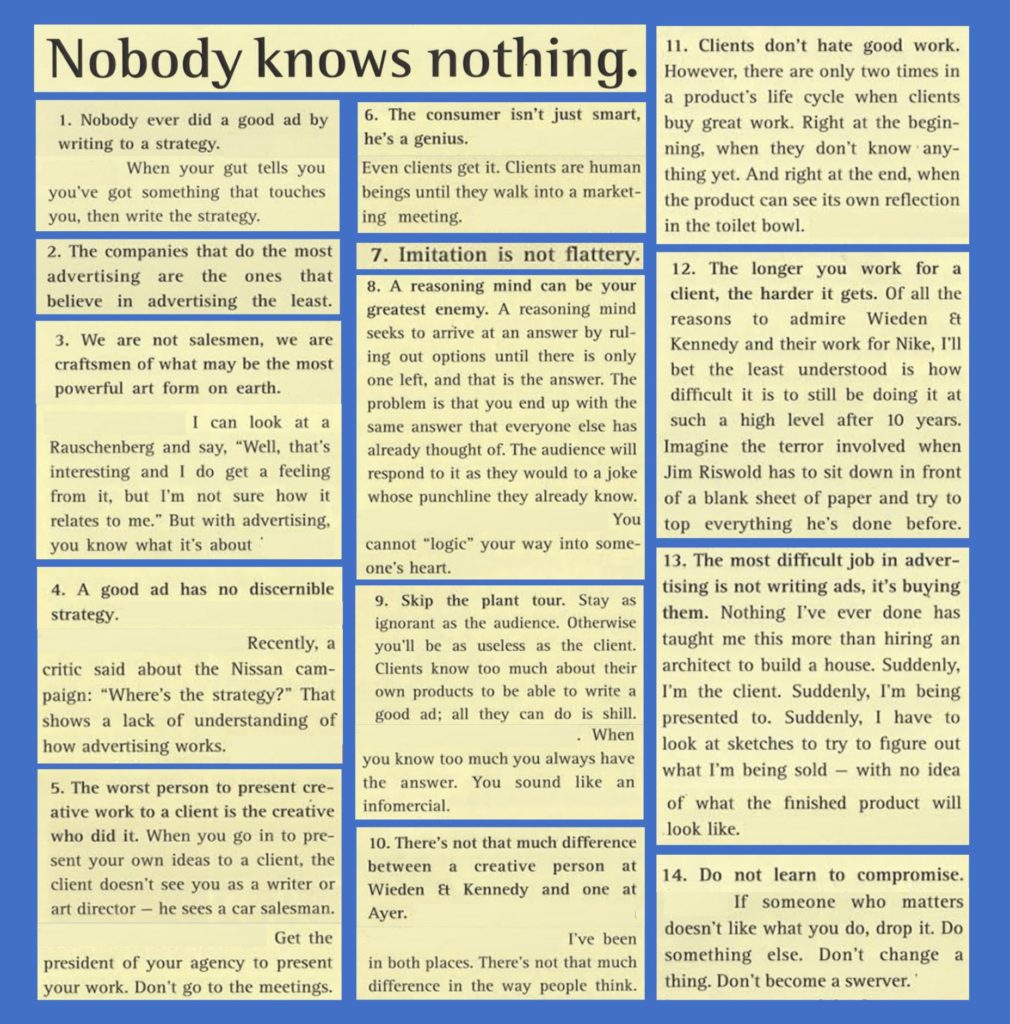
“Anti-laws” of advertising

I don’t agree with all of these, but there’s a lot of gems within. Happy Friday!

Anti-laws of advertising

Source: @v_praveen

March 4, 2021

Single-focus marketing

I recently bought a new iPhone 12 and got the leather case with it.

I was surprised to see how bulky it all felt after my last phone.

Sure, it was a slightly bigger phone (by a little), but with the new case too, it felt quite clunky by comparison.

Enter: Peel

Peel focuses on making the thinnest cases for your iPhone or Android device. That’s all I know about them, but it was enough to make me think of them, seek them out, then buy a new case for that very reason.

Sometimes, good marketing is about picking one thing and going to the edges with it.

So, what are you the only/most/best at?

Try focusing on that one thing in your marketing and let people uncover all the other benefits of your products and services later on.

peel website

March 1, 2021

Steven Pressfield and The Resistance

I’m in the process of listening to an interview with Steven Pressfield by Tim Ferris on his podcast, The Tim Ferris Show.

If you’re not familiar with Steven Pressfield, he’s written some great books, including The War of Art, Do The Work, and Nobody Wants to Read Your Sh*t”.

One of his major themes is an idea called the Resistance. The idea is ultimately about the feeling of fear you get when you create something new, such as writing a book or other creative ventures.

It’s the little voice inside your head that says you’re not good enough, or it’s time to quit, or to procrastinate. Or many other forms of discouragement.

If you listen to that voice, it will ultimately doom you to live life as your “shadow” self; doing something similar to but not quite what you wish you could be doing.

Here’s some quotes from his book, The War of Art:

“Resistance will tell you anything to keep you from doing your work. … If you take Resistance at its word, you deserve everything you get. Resistance is always lying and always full of shit.”

“Fear is good. Like self-doubt, fear is an indicator. Fear tells us what we have to do.

Remember our rule of thumb: The more scared we are of a work or calling, the more sure we can be that we have to do it.

Resistance is experienced as fear; the degree of fear equates to the strength of Resistance. Therefore the more fear we feel about a specific enterprise, the more certain we can be that that enterprise is important to us and to the growth of our soul. That’s why we feel so much Resistance. If it meant nothing to us, there’d be no Resistance.”

“Rule of thumb: The more important a call or action is to our soul’s evolution, the Resistance we will feel toward pursuing it.”

If you haven’t read them, you must read The War of Art and his other books. Especially the ones I mentioned at the top of this article.

I also suggest listening to the Tim Ferris interview as they cover a lot of topics that any creative or entrepreneurial professional will resonate with.

Here’s a link to the episode.

February 24, 2021

Assuming success in any niche

Assume you could be successful at serving any audience.

Who would it be and why?

What’s stopping you from working with them?

What research can you do to understand what they need so you can sell things to them to sustain a business?

My guess is you could succeed in serving almost any niche.

Don’t let your mind trick you into thinking one market or another can’t sustain a business. It’s rarely true.

You just need to figure out what you can offer them that they actually want at a price that works for everyone.

  • « Go to Previous Page
  • Go to page 1
  • Interim pages omitted …
  • Go to page 13
  • Go to page 14
  • Go to page 15
  • Go to page 16
  • Go to page 17
  • Interim pages omitted …
  • Go to page 22
  • Go to Next Page »

More:  Consulting · YouTube · Contact

Member Login

Please don’t reproduce anything on this website without permission.

Copyright © 2026 · Kevin C. Whelan · All prices in USD.